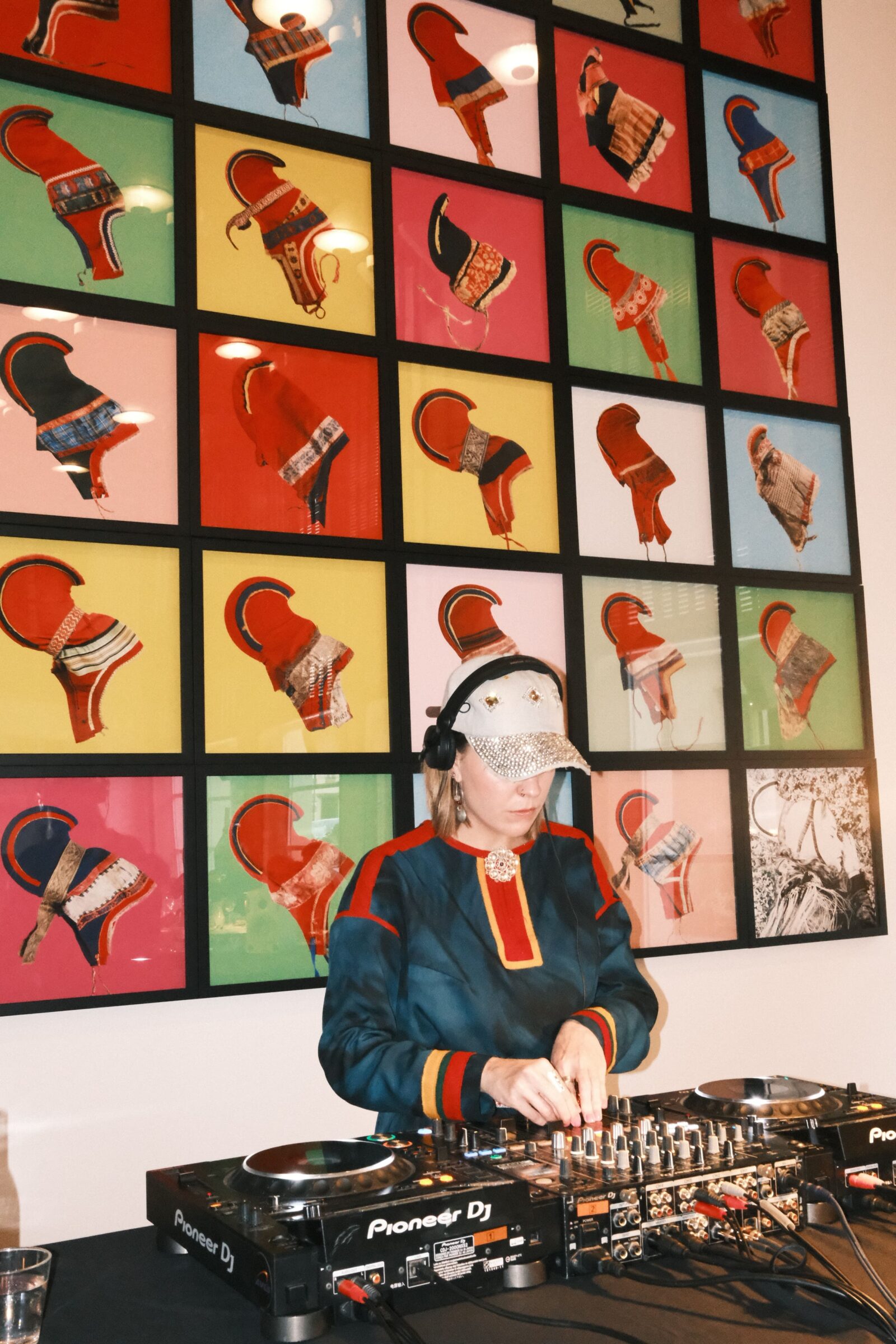
DJ Hulluella, Eleonora Alariesto’s creative alter ego, was born as an inside joke that has since taken her from Rovaniemi to Tokyo. Drawing on her Sámi heritage as a source of creativity, Eleonora wants to break free from cultural stereotypes about the Sámi. As one of the emerging figures in contemporary Sámi culture, she has found her passion in DJing and a way to use it as an outlet for getting her message heard.
Before the interview begins, one question is already present: am I talking to Eleonora Alariesto or DJ Hulluella?
Dressed in an outfit that combines elements of traditional Sámi dress, gákti, handcrafted silver jewellery and colours symbolising her family ties in the Northern Sámi region, she has paired it with fishnet stockings, chunky leather boots and a denim cap decorated with fake diamonds.
The aesthetic mixture also reflects the diversity of both Eleonora Alariesto and the artistic universe of her creative alter ego, DJ Hulluella. It quickly becomes clear that the two exist at the same time, but in different roles.
Eleonora Alariesto is a freelance journalist, host of the podcast “Mii gullo…?” and producer, with most of her current projects connected in some way to Sámi culture.
DJ Hulluella also draws inspiration from Sámi culture and the community, bringing it into the creative world. But the journey towards a life as an artist started with a joke:
“My Instagram handle was DJHulluella before I even started deejaying. When people asked if I really played DJ gigs, I always joked around and said yes until I actually played my first set at my old student association’s yearly annual gala. After that, I started to learn to play records more seriously with the help of my friend. So, in a way, nomen est omen, and the whole DJ thing manifested itself.”
The development of her own sound as a DJ hasn’t been linear, but rather a constant and dynamic process. The soundscape of DJ Hulluella could be described as “genre-fluid”. Inspired by niche subcategories of electronic music and bass-heavy sounds, she is developing a distinctive musical landscape of her own.
“The sound I want to make doesn’t exist yet.”
On top of her Sámi background, DJ Hulluella draws inspiration from across the world. She likes to describe her music as “planetaric” – a sound that combines different genres, cultures and languages.
“Some would describe it as ethnic music, but personally, I hate that term. It entails that something is seen as standard, and then you compare it through an othering gaze, resulting in the other being viewed as “ethnic”. The term planetary sound captures the equal nature of music better.”
DJ Hulluella is also cautious about being seen as a representative of the Sámi community and culture through her artistic work. It is a label she carries with pride, but she is also aware of its limitations:
“I can’t separate my Sámi background from me; it is an integral part of my identity and what I do, but it’s up to me to decide how much I let it define me. It would feel insincere to only take advantage of that label. For example, there are Sámi DJs who only play Sámi Indigenous music, but I don’t fully fit in that box.”
Having played both domestically and internationally, DJ Hulluella describes performing abroad as more liberating, both professionally and personally. She says that the club culture in places like London is much bigger and more diverse than in Finland, providing a completely different setup for performing and challenging yourself as an artist.
DJ Hulluella also describes performing outside the Nordic region as a break from the stereotypes that people attach to Sámi culture. Elsewhere, Sámi culture is treated as just one of many cultural backgrounds present in society:
“I’ve performed in Norway and Sweden in places where the Sámi background is the main context, and then the setup of me performing as a Sámi DJ is a much bigger thing, both politically and culturally. It’s liberating to go to places like Tokyo, where nobody cares that I’m Sámi. As a performer, I’m still seeking the balance between being incognito and being seen as a representative of Sámi.”
Still exploring her own unique sound, DJ Hulluella mentions making and producing her own music and collaborating with other Indigenous artists as some of her future goals. Having built an impressive CV as an artist in only a few years, she still has a very humble approach to her craft.
“I feel that I’ve already achieved many of my career goals. I never imagined that I would be where I am today three years ago. Being a DJ is so unpredictable – every gig is still a blessing for me.”
Switching the focus back to Eleonora Alariesto, who is actively shaping and creating contemporary Sámi culture outside the music scene.
Having started out as an academic specialising in Sámi culture and politics, she found the research perspective to be too exhausting at that time. Referring to herself as a “meta-analytic person”, she admits that she will never be able to let go of the political and activist approach to Sámi topics, but for now she is focusing more on the creative aspects of her work.
As one example of her work at the intersection of activism, politics, art and culture, Eleonora names Arctic Pride and Sápmi Pride, where she has performed.
“The Pride events are super important to our community because we get to meet other Sámi people from the LGBTQI+ community across national borders. Many queer people in the North spend time alone or in their own small communities. Pride is so important for feeling seen and validated, because some people in the rural communities are still quite conservative and not that open-minded.”
Being part of the queer community herself, Eleonora feels that performing as DJ Hulluella during Pride events is especially important and meaningful.
“It is such a big honour to be able to bring so much joy and happiness to our queer community, because joy is something we really need in this world. Club nights and music can bring people exactly that.”
Text: Ella Fokin
Photo: Silva Kaverinen